Category: SME

  • What a Professional Invoice Looks Like in Nigeria (And How to Send One in Under 60 Seconds)

    What a Professional Invoice Looks Like in Nigeria (And How to Send One in Under 60 Seconds)

    Let me be straight with you. If you have been sending your GTB account number on WhatsApp and calling it an invoice, you are not alone. Most Nigerian freelancers do exactly the same thing.

    The problem is that what looks like a shortcut is actually costing you money and costing you credibility.

    A client who receives a proper invoice with your business name, a due date, a payment link, and a reference number treats it very differently from a message that reads “Please pay to 0123456789 GTB’” One looks like a business request and the other looks like a favour.

    In this article, I will show you what a professional invoice must include, why each element matters for getting paid, and how you can send one in under 60 seconds without designing anything from scratch.

    1. What Clients See When You Send Your Account Number

    Here is what happens in a client’s head when you send your bank details on WhatsApp with no context. They see a message, they intend to pay but then they get distracted, attend a meeting, or simply forget because there is no due date staring at them and no document sitting in their email.

    According to research on Nigeria’s invoice gap published by Digital Times Nigeria, Nigerian SME owners regularly spend hours babysitting receivables instead of serving clients because payment follow-ups happen entirely through memory and manual messages. An invoice goes out, a WhatsApp reminder follows, then another, then another.

    When you send a proper invoice, the dynamic shifts. There is a document that shows a due date, a breakdown of what was delivered, and a clear path to payment. It removes ambiguity and places accountability on the client.

    That is the first reason a professional invoice matters, it is not about looking fancy, it is about creating a paper trail that both sides take seriously.

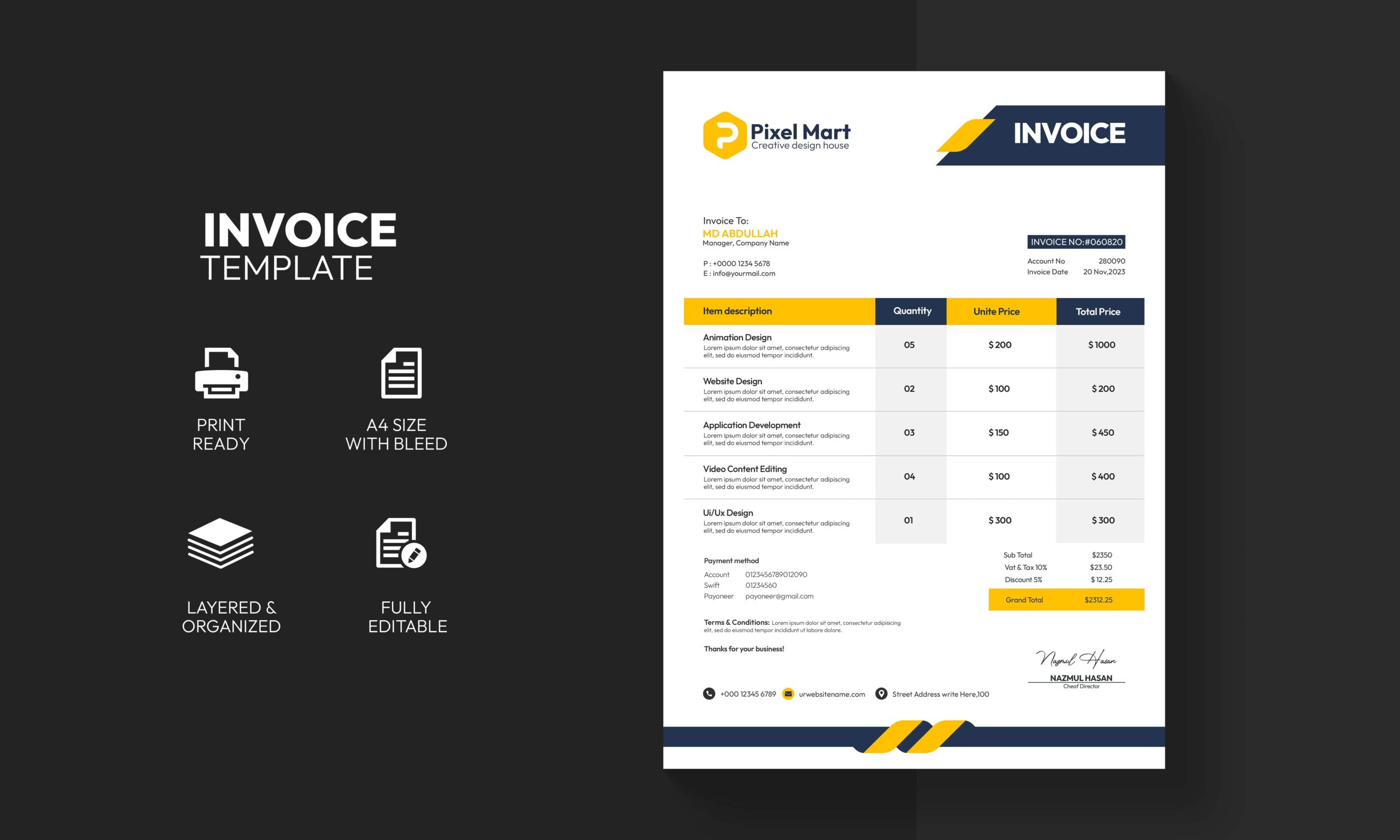
    2. What a Real Invoice Must Include

    I have seen invoices that are nothing more than a table in a Word document with no contact details, no due date, and no payment method. If your invoice is missing even one of these elements, you are slowing down your own payment.

    Here is what every professional invoice in Nigeria must have:

    • Your full name or business name: This should be the first thing a client sees. If you operate under a brand name like “Tunde Creative Studio,” then that name goes at the top.
    • Your contact details: Phone number, email, and optionally your location, this gives the client a way to reach you if there is a query before payment.
    • Client name and contact details: Spell their name or company name correctly. This matters especially when an invoice passes through a finance department.
    • Invoice number: A unique reference like INV-001 or INV-20260512. This makes tracking and follow-up much cleaner. When you call to follow up, you can both refer to the same document.
    • Invoice date and payment due date: Without a due date, the client decides when to pay. With a due date, there is a shared expectation. “Due within 7 days” or “Due: 19 May 2026” both work.
    • Itemised list of services: List each service clearly with a description, quantity, rate, and total. “Social media management — April 2026, ₦85,000” is far better than just writing ₦85,000.
    • Total amount due: State this clearly in Nigerian Naira (or the agreed currency). If VAT or withholding tax applies, show it as a separate line so there is no confusion.
    • Payment method or payment link: This is the one most Nigerian freelancers skip. If you include a Paystack or Flutterwave payment link, the client can pay with a card or bank transfer in seconds. Without a link, they have to open their bank app, type in your account number, and hope they get it right.

    As noted by ProInvoice’s guide to freelance invoicing in Nigeria, professional invoices that clearly state payment terms and methods get paid faster because they reduce friction at every step of the process.

    3. The 8 Invoice Fields That Get You Paid Faster

    Let me break this down even further.

    These eight fields are the ones that most directly affect how quickly you receive your money. Think of them as the difference between a client who pays within 48 hours and one you are still chasing two weeks later.

    Field 1: Invoice number

    A numbered invoice is a professional invoice. It also makes your follow-up message sound organised rather than desperate. Compare ‘Have you paid?’ with ‘I wanted to check on Invoice INV-014, due 15 May 2026.’ One gets ignored. The other gets a response.

    Field 2: Due date

    Your payment terms need to be stated clearly. Net 7 means payment is due within 7 days. Net 14 is 14 days. If you do not state a due date, you have no grounds for a follow-up because you have not set an expectation.

    Field 3: Itemised service breakdown

    Clients approve invoices faster when they can see exactly what they are paying for. A vague line that says ‘design work — ₦150,000’ may go back for clarification. ‘Logo design + brand guidelines + 3 revision rounds — ₦150,000’ gets approved the same day.

    Field 4: Your branding

    Your logo and business name at the top of the invoice signal that you run a real business. Corporate clients in particular need to see a business name they can raise a purchase order against.

    Field 5: Payment link

    I keep coming back to this one because it is the biggest gap I see. When you include a Paystack, you eliminate the step where the client has to look up your account details, copy them, and make a manual transfer. A one-tap payment link converts faster.

    Field 6: Currency

    Always state the currency on your invoice. NGN, USD, GBP — whatever you agreed. Ambiguity here creates disputes, especially when working with international clients or companies that process payments through finance teams.

    Field 7: Tax information (if applicable)

    If you have a CAC registration or Tax ID, include it. Corporate clients often require this before processing payment. And if you are charging VAT or subject to withholding tax, make sure that is reflected clearly on the invoice rather than raised as a surprise afterwards.

    Field 8: A short thank-you note or payment instruction

    Something like ‘Thank you for your business. Payment is expected by [date]. Please use the link above or transfer to the account details listed below.’ It sounds small, but it sets a polite, clear tone that professional clients respond to.

    4. Multi-Currency Invoicing: Getting Paid in GBP, USD, or EUR as a Nigerian Freelancer

    If you work with international clients, your invoicing setup needs to reflect that. Sending a Naira invoice to a client in London creates a conversion problem on their end and can delay payment by days as they try to work out what the transfer amount should be.

    A professional multi-currency invoice states the amount in the client’s preferred currency and, optionally, the Naira equivalent at the current exchange rate. It also clearly states which account they should pay to whether that is a Wise, Grey, or Payoneer account for USD or GBP transfers.

    As covered in NairaCompare’s guide to payment platforms for Nigerian freelancers, Nigerian freelancers working with international clients need invoicing tools that support multiple currencies natively. Sending an invoice with a payment link that only accepts Naira to a client in the UK creates unnecessary friction.

    5. The WhatsApp Invoice: Sending Professionally Without Email

    WhatsApp is where Nigerian business happens. Most of your clients check WhatsApp more than they check email, so sending your invoice there is not unprofessional. What is unprofessional is sending an unformatted image with bank details typed over a white background.

    A proper WhatsApp invoice looks like this: a PDF or link that opens to a clean, branded document with your business name, the service details, the due date, and a button the client can tap to pay. That is completely different from a screenshot.

    The BIZ301 freelance invoicing guide for Nigeria points out that digital invoices sent directly to clients get paid, on average, faster than those sent by other means, largely because the document is immediately actionable.

    With Velvy, you can send a professional invoice directly through WhatsApp in one tap. The client receives a link, opens it, sees a properly formatted invoice with a payment button, and pays without needing to switch apps or type in account numbers manually.

    6. Create Your First Professional Invoice Right Now

    Here is the part where I show you just how fast this can be. Most people assume that setting up a professional invoice system takes hours. It does not. Velvy gets you to your first invoice in under 60 seconds.

    This is what the process looks like:

    • Sign up free at velvy.app, no payment required.
    • Enter your business name and logo, this takes roughly 30 seconds.
    • Add your client’s details — name, email, or phone number.
    • List your service, rate, and due date.
    • Hit send. Velvy generates a professional PDF and gives you a payment link in seconds.
    • Share via WhatsApp, email, or a direct link. Your client pays with one tap.

    You get a notification when the invoice is viewed and when it is paid. No more guessing whether they received it. No more awkward follow-up messages asking if they got the invoice you sent.

    The free plan covers five invoices per month, more than enough if you are just starting out. When you start landing more clients, you can upgrade to our premium subscription which gives you unlimited invoices, automatic payment reminders, and access to Zino, Velvy’s WhatsApp AI assistant that helps you manage your business from a chat window.

    The Bottom Line

    Sending your bank account on WhatsApp is not invoicing. It is hoping. A proper invoice with clear fields, a payment link, and a due date removes the friction between you and your money.

    The invoicing upgrade that most Nigerian freelancers need is not complicated or expensive. It is just a shift from informal to structured and it starts with the next invoice you send.

    Send your first professional invoice in 60 seconds free on Velvy. No payment required.

    Related resources

  • Revenue vs Profit: The Difference That Is Silently Killing Nigerian Small Businesses

    Revenue vs Profit: The Difference That Is Silently Killing Nigerian Small Businesses

    I want to tell you about a conversation I have had more times than I can count.

    Someone DMs me or pulls me aside at an event. They are excited. They just had their best month ever, five hundred thousand naira in sales, maybe eight hundred, maybe more. They are glowing and then, almost as an afterthought, they say: “But I don’t know where my money went.”

    That sentence. “I don’t know where my money went.”

    It is the most common sentence in Nigerian small business and it is not because the person is careless or irresponsible. It is because nobody ever sat them down and explained the difference between two numbers that look similar but mean completely different things.

    Revenue and profit.

    Once you understand the difference and really understand it, not just the textbook definition, a lot of the confusion about your business finances will start to clear.

    So let me walk you through it the way I wish someone had walked me through it.

    Let Me Start With a Story You Will Recognise

    Chidinma sells fashion items on Instagram, she had her best month yet, about ₦800,000 in sales. She screenshot every credit alert, she posted a gratitude reel, she told her mum things were finally moving.

    By the 28th of the same month, she had only ₦35,000 in her account.

    She did not get robbed, nothing dramatic happened, she just spent the money. Not recklessly as one will naturally think, she spent it on the business, Stock, Deliveries, Packaging, Data, Ads, a little for herself, all reasonable things.

    But she had no idea what she actually kept from that ₦800,000 and that is where the problem lies.

    You can make a lot of sales and still be broke. In fact, you can be growing your sales month on month and still be getting poorer if you do not know what is staying with you versus what is passing through.

    That is the revenue-profit gap and it is quietly ruining businesses that look successful from the outside.

    Here’s a number that should stop you cold:In 2024, 65% of informal Nigerian businesses reported revenue growth but only 47% saw an increase in profit. Nearly 8 in 10 said their cost of doing business went up. Revenue rising. Profit not following. That gap is not a coincidence, it is what happens when you do not track both numbers.

    What These Two Words Actually Mean

    I know you have probably heard both terms before but I want to be precise, because the confusion is real and it is costing people money.

    Revenue is the total amount of money that comes into your business. Every sale, every client payment, every transfer. If orders totalling ₦800,000 cleared this month, your revenue is ₦800,000. That’s it, nothing is subtracted yet.

    Profit is what you have left after subtracting everything it cost you to make those sales, Stock, Packaging, Delivery, Data, Ads, Bank charges, Generator fuel, Transport, Your own salary if you pay yourself one and everything else.

    The formula is not complicated:

    Revenue  −  Total Expenses  =  Profit

    Simple, right? The issue is not the formula. The issue is that most people know their revenue number intimately, they feel every credit alert but their expenses are a blur.

    They are paid one by one, often mixed with personal spending, and never added up until it’s too late to do anything about it.

    Revenue is what looks good in your captions, profit is what you can actually use.

    Here Is Where Your Money Is Actually Going

    Let me show you what Chidinma’s ₦800,000 month probably looked like, in real numbers. This is not hypothetical, I built this from the kind of expense breakdowns I see from Lagos-based Instagram sellers constantly.

    Where the money wentAmount (₦)
    Stock and inventory purchases350,000
    Packaging (bags, tissue, tags, stickers)18,000
    Delivery and logistics fees22,000
    Data — phone and Wi-Fi router8,500
    Instagram ads and promotions30,000
    Bank charges and transfer fees3,200
    Generator fuel (home office)15,000
    Transport (market runs, drop-offs)12,000
    Personal withdrawal (‘salary’ this month)80,000
    Damaged or unsold stock written off25,000
    Total Expenses563,700
    Profit (Revenue ₦800k − Expenses ₦563.7k)₦236,300

    So her real profit is ₦236,300. Not bad at all, honestly. Certainly not ₦35,000.

    So why was her account almost empty by the 28th?

    Two things happened. First, she restocked immediately after the big sales came in, which meant most of that profit went straight back into new inventory before she could see it as money.

    Second, she and her business share one account, so when she spent ₦80,000 on herself across the month, there was no system distinguishing “business expense” from “I felt like buying something.”

    This is not a character flaw, It is a system problem and I say that because I want you to fix the system, not beat yourself up.

    The Expenses You Are Probably Not Counting

    The big-ticket expenses you always remember are probably rent. stocks, staff salaries if you have them but what actually kills you are the quiet stuff.

    Let me go through the ones I see people miss most often:

    • Bank charges and transfer fees: Every USSD transaction, every account maintenance fee, every inward transfer charge. At ₦50–₦100 per transfer, a busy month adds up fast. I have seen people spending ₦5,000–₦8,000 monthly in bank fees they never once wrote down.
    • Paystack fees. If you collect payments via Paystack, they charge 1.5% per transaction, capped at ₦2,000. On ₦800,000 in sales, that’s ₦12,000 leaving before the money even reaches your account. When did you last account for that?
    • Generator fuel. NEPA is not going to be reliable anytime soon. If you run a home office or a small studio in Lagos, you are spending between ₦10,000 and ₦25,000 monthly on fuel. I almost never see this in anyone’s expense records.
    • Your own time and transport. The Bolt to the market. The bus fare to drop off an order. The data you spend answering customer DMs at 11pm. Your time has a cost. Your transport has a cost. If you are not tracking it, you are subsidising the business with your own money and calling it a sacrifice.
    • Damaged or unsold stock. If you are in fashion, food, or beauty, some percentage of what you buy will never sell, or will get damaged in delivery. Writing it off properly is the honest way to account for your real profit. Most people just absorb it and wonder why the numbers feel off.

    According to research on African SME operations, hidden costs consistently represent 20–30% of monthly expenses in small African businesses. That means for every ₦100 you think you’re spending, another ₦20–₦30 is quietly leaving without being recorded.

    And there is one more that sits above all of these:

    Mixing personal and business money. When you have one account for everything, every personal expense becomes a business expense by default even if you never intended it that way. This one habit is one of the major reasons why people can’t tell what their actual profit is.

    How to Calculate Your Real Profit (Do This Right Now)

    I am not going to give you a complicated framework, I am going to give you five steps. Do them at the end of this month, actually do them.

    1. Write down every naira that came into the business. Sales, payments, transfers, cash from customers. All of it. This is your revenue number.
    2. Write down every naira that left. Stock. Packaging. Logistics. Data. Ads. Fuel. Bank charges. Everything you paid for to run the business this month. Do not leave anything out because it feels too small.
    3. Add up what you took out for personal use. Every grocery purchase from the business account. Every personal Bolt ride charged to the business. Every random withdrawal. Put a real number on it and include it in your expenses.
    4. Subtract total expenses from revenue. That number is your profit. If it is low, you now know why. If it is negative, the business is running on borrowed time and you also need to know that.
    5. Compare to last month. Is profit going up as sales grow? Or is revenue climbing while profit stays flat? A gap between those two trends is your signal that costs are getting out of hand.

    One thing worth knowing: Nigeria’s Tax Act 2025 taxes your profits, not your revenue. That means the government will ask what you kept after expenses. If you have no expense records, you cannot defend that number. Knowing your real profit is not just good business sense, it is also how you stay on the right side of FIRS.

    The Habits That Actually Help

    Knowing you should track your expenses and actually tracking them are two different things. So let me tell you what genuinely works, not what sounds good in theory.

    Separate your accounts. I cannot stress this enough. Business income goes into one place. Personal spending comes from another. You do not need a fancy corporate account to start a second personal account works. The moment you separate them, your finances will start to make sense in a way they never have before.

    Record expenses the moment they happen. Not at the end of the week. Not when you remember. The moment money leaves, write it down. Delayed recording is where accuracy goes to die. A week later you will not remember what that ₦3,200 transfer was for.

    Do not skip the small amounts. I know ₦1,500 for packaging feels too small to bother writing down but do it anyway. Add up 15 of those across a month and you have ₦22,500 that your profit calculation knows nothing about.

    Review weekly, not monthly. A monthly review tells you what went wrong. A weekly review gives you a chance to fix it. There is a big difference between catching a cost problem on the 10th of the month and finding out on the 30th.

    If you want to go deeper on how real Nigerian business owners actually think about costs, this Zikoko piece is honest and practical. Business owners walk through their actual pricing logic, hidden costs included. Worth reading.

    How Velvy Handles This For You

    I will be direct: doing all of this manually is genuinely hard, not because the steps are complicated, but because you are also running a business.

    You have orders to fulfil, customers to reply to, suppliers to chase. Sitting down to reconcile expenses at the end of the month often loses out to everything else that is more urgent.

    This is what I like about Velvy for this exact problem. When a client pays an invoice, the revenue is recorded automatically. When you log an expense, which takes about 10 seconds, it sits against your revenue. At any point, you can open the dashboard and see your revenue, your expenses, and your actual profit, not an estimate but the real number.

    There is also Zino, which is Velvy’s WhatsApp AI assistant. If you live in WhatsApp like most Nigerian business owners do, you can literally message Zino “Log expense of ₦12,000 on packaging today” and it is logged. No app to open, no form to fill in, It just goes into your records.

    You can start free at velvy.app. The first five invoices are on them. But beyond invoicing, it is the expense tracking and the profit view that I think will change how you see your business.

    The Thing I Want You to Walk Away With

    Revenue is the exciting number. Everyone talks about it. “I made ₦500k this month.” “I crossed a million.”

    Profit is the honest number. And it is the only one that tells you if your business is actually working.

    I have seen businesses with ₦2 million in monthly revenue that were quietly collapsing and I have seen businesses with ₦400,000 in monthly revenue that were stable, growing, and paying their owners well.

    The difference was not the sales number. It was the profit number and whether the owner knew it and made decisions based on it.

    Start tracking yours this month even if it is messy. Even if you are playing catch-up on two months of unrecorded expenses. The clarity that comes from knowing your real profit will change how you price, how you spend, and what decisions you make.

    You cannot grow a number you are not watching.

    Sources and further reading

    38% of Nigeria’s SMEs make under ₦10,000 profit daily — TechCabal / Moniepoint 2025

    The Hidden Cost of Doing Business in Nigeria — DoingBusinessInNigeria.org

    Why Your Profitable Business Is Running Out of Cash — Medium

    Hidden Expenses Draining Cash Flow in African SMEs — Built.Africa

    5 Invoicing Mistakes Costing You Clients — Velvy BlogExplore Velvy’s features — velvy.app/features